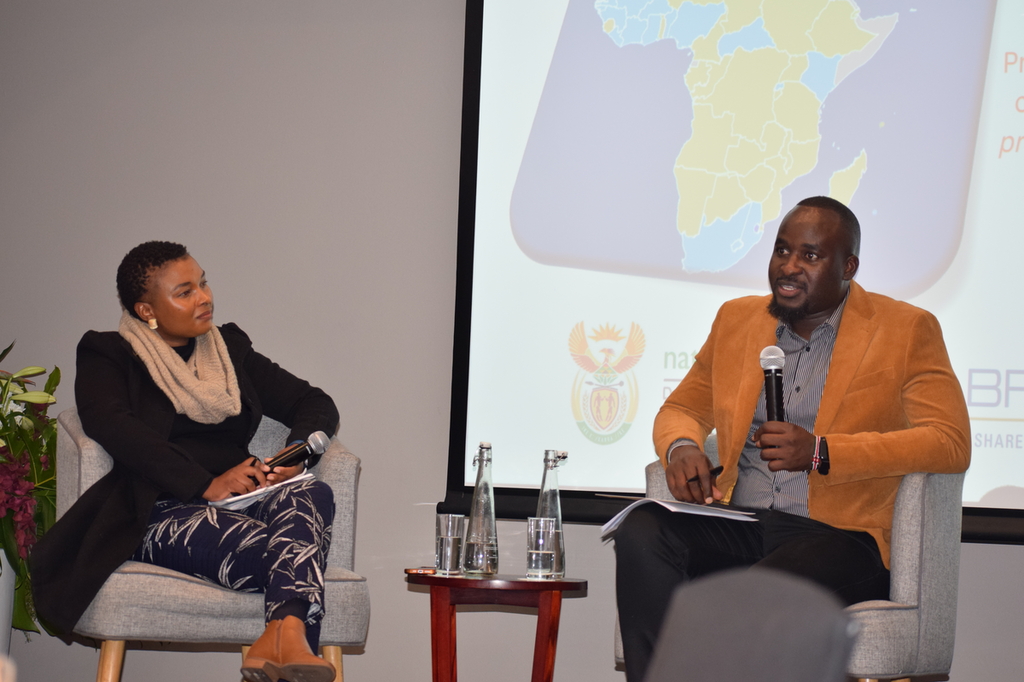
From left to right : Prudence Cele, Director at the South Africa National Treasury and Dr Nixon Murathi Kiratu, Principal Economist for the Government of Kenya
On 25 June, the South Africa National Treasury (SANT) in collaboration with CABRI held a fireside chat on the theme, “Changes in budget practices and procedures in response to rapidly shifting country environments.” The event was held as part of CABRI's General Assembly meeting which was hosted by South Africa last week.
Moderated by Dr Kay Brown, Executive Secretary of CABRI, the fireside chat was led by Prudence Cele, Director at the SANT and Dr Nixon Murathi Kiratu, Principal Economist for the Government of Kenya. The conversation was inspired by evidence from CABRI's Budget Practices and Procedures (BPP) 2025 which shows that both South Africa and Kenya have moved beyond basic public financial management (PFM) reform toward system refinement within already institutionalised frameworks.
A key shared dynamic is that the most significant changes are no longer purely technical, but increasingly contextual and environmental. In Kenya, this is driven largely by expanding public participation, digitalisation of fiscal systems, and pressure to improve transparency and revenue mobilisation, particularly through formalisation of the informal sector. In South Africa, the dominant shift is shaped by political transition toward coalition governance and tightening fiscal space. In both cases, the core PFM architecture remains stable, while reforms are increasingly focused on how the system operates under pressure, whether from public demand for openness in Kenya or political negotiation constraints in South Africa.
Despite these differences in drivers, both countries face a shared challenge of balancing openness with fiscal authority and control. Kenya’s experience reflects increasing citizen engagement, digital transparency tools, and evolving participation mechanisms that sometimes complicate fiscal decision-making, while South Africa’s experience reflects intensified political negotiation and consultation within a constrained fiscal environment. In both contexts, the central tension is how to maintain credible fiscal discipline and executive responsibility for budgeting while responding to growing demands for transparency, accountability, and broader stakeholder influence in the budget process.