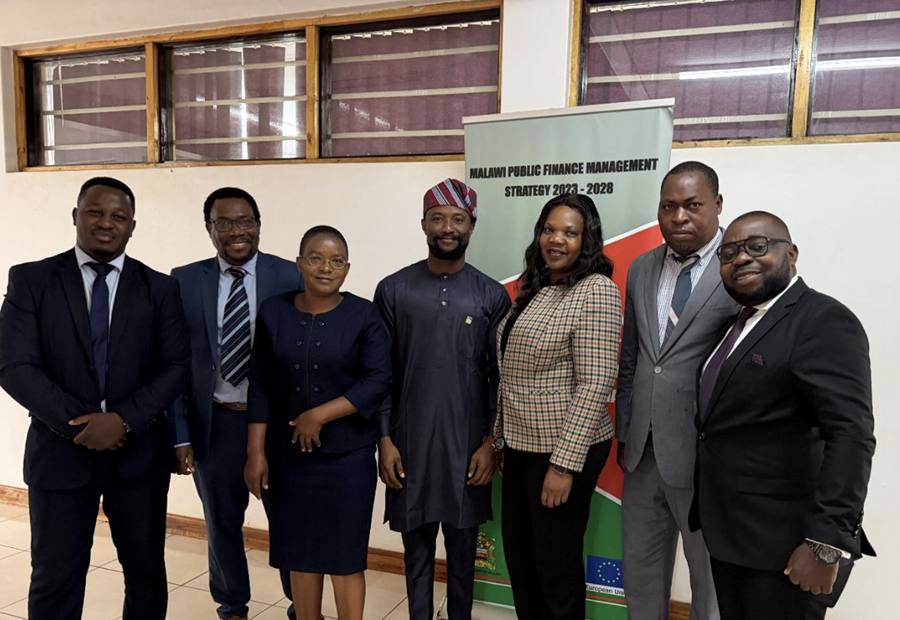
Olaniyi Olaleye, PFM Specialist at CABRI was in Malawi this month for a country check-in. During his visit, he paid a courtesy visit to the Ministry of Finance, Economic Planning and Development.
The Building Public Finance Capabilities for Health (BPFCH) programme, implemented by CABRI with support from the Global Fund, is helping multidisciplinary teams from ministries of finance and health tackle complex public finance challenges using the Problem-driven Iterative Adaptation (PDIA) approach.
Recent in-country coaching visits to Malawi, Rwanda and Nigeria provided an opportunity to take stock of progress, reflect on lessons, engage senior decision-makers and stakeholders, and refine the teams' next steps. Although each country is tackling a different challenge, several common themes emerged: stronger collaboration between finance and health officials, increasing ownership by senior leadership, and a growing appreciation that sustainable reform requires continuous learning rather than one-off technical fixes.
Rwanda: improving alignment between donor funding and national priorities
Problem statement: The health sector faces challenges in aligning donors' priorities with national plans, resulting in critical financing gaps in the implementation of health strategies.
Rwanda's coaching visit combined induction of new team members, progress review and extensive stakeholder engagement. The visit helped the team reassess activities that had previously been considered complete, clarify responsibilities and agree a more focused set of next steps while reinforcing the importance of Ministry of Finance participation.
The team has already made tangible progress. Among its early achievements are the development of a project performance dashboard to improve visibility of implementation, a joint planning and budgeting retreat that identified gaps between donor-funded projects and national health priorities, and the establishment of a Grants Review Committee whose recommendations support more efficient use of donor resources. The team also reviewed Ministry of Health projects to identify delays in donor disbursements and procurement approvals.
The coach met senior leaders from the Ministry of Health, Ministry of Finance, the Rwanda Biomedical Centre and officials responsible for planning, development finance and project oversight. These discussions generated valuable insights, including opportunities to strengthen planning capacity, improve project tracking, upgrade information systems and better align development partner financing with national priorities.
Several important lessons emerged. Strong senior management support – particularly from the Permanent Secretary in the Ministry of Health – has been instrumental in maintaining momentum. At the same time, the visit reinforced that meaningful progress depends on sustained participation from both ministries, making continued Ministry of Finance engagement a priority.
Looking ahead, the team plans to establish a technical working group to monitor alignment between projects and national priorities, undertake expenditure efficiency analysis of donor-funded projects, analyse delays affecting disbursements and procurement at the Rwanda Biomedical Centre, and strengthen Ministry of Finance representation within the programme.
Malawi: strengthening primary healthcare through better coordination
Problem statement: Delayed access to care at primary healthcare level in Malawi affects 8.8% of clients, compromising timely treatment, worsening health outcomes, and increasing costs.
An important feature of the Malawi visit was engagement with senior leadership from both Ministry of Finance and Health. The team met with the Ministry of Health Principal Secretary, who confirmed that the problem statement is closely aligned with national priorities and the identification of primary health care (PHC) as the strategic priority for improving health outcomes. Discussions with senior Ministry of Finance officials focused on financing pathways for the health sector, including domestic resource mobilisation, strengthening district-level financing to address PHC financing constraints, and coordination of development partner financing.
The team has made progress towards establishing a baseline to assess the alignment of external financing with government priorities and systems. This includes measuring the proportion of external financing that is channelled through government budgets versus off-budget mechanisms, as well as the extent to which donor financing aligns with national priorities. The baseline will provide a reference point for tracking progress over time towards greater alignment and integration of external financing into government systems.
The visit concluded with a broader stakeholder consultation involving representatives from the Ministries of Health, Finance, Budget and Planning, and Local Government. The Malawi visit demonstrated how structured reflection and broad stakeholder engagement can build consensus around a complex systems challenge before moving into implementation.
The team will, over the next three months, engage with other government sectors implementing a Sector-Wide Approach (SWAp) to identify lessons on pooling and coordinating development partner resources that can be adapted to strengthen coordination and alignment of health financing. The team will also revive discussions on the Partner Engagement Framework to reinforce government leadership in coordinating development partner investments, improve alignment with national health priorities and reduce fragmented financing.
Nigeria: improving visibility of health expenditure
Problem statement: Across many subnational systems, limited visibility of health expenditures has hindered efficiency and ultimately affected health outcomes.
Nigeria's five-day coaching visit focused on strengthening the team's shared understanding of the problem, refining entry points for reform and developing a practical 90-day action plan. The team reaffirmed its diagnosis of weak expenditure visibility while identifying four complementary areas for action: improving health coding within government financial management systems, institutionalising quarterly expenditure reviews, strengthening subnational public financial management capacity, and improving alignment between national planning and budgeting processes.
A significant development during the visit was the addition of a fourth reform area following discussions with the Ministry of Finance authoriser, who emphasised that stronger alignment between the National Development Plan, Medium-term Sector Strategies and annual budgets is fundamental to improving health financing. Rather than viewing this as a competing priority, the team successfully integrated it into its broader reform agenda.
The team's next steps include auditing health expenditure codes within the financial management information system, producing a prototype quarterly health expenditure report, piloting public financial management orientation in selected states, undertaking diagnostic work on planning and budget alignment, and maintaining regular engagement with authorisers.
Building reform through iteration
Across all three countries, the coaching visits reinforced one of the PDIA's central principles: sustainable reform emerges through experimentation, reflection and adaptation rather than rigid implementation plans. The visits gave teams dedicated time to step back from day-to-day responsibilities, reassess progress honestly, engage influential stakeholders and refine their priorities based on what they had learned.
While each country is addressing a different challenge, the teams are following a common path: building stronger relationships between ministries of finance and health, generating evidence to support decision-making, and creating practical, country-owned solutions that can continue evolving long after the programme concludes. Visits to the remaining countries in the programme – Tanzania, Cote d’Ivoire, Burkina Faso and Ethiopia – will take place in the second half of the year.